

WHAT HAPPENS DURING A FORENSIC INTERVIEW?
When a child is referred to our agency for a forensic interview, you might be wondering what they actually do when they get here.
Our process actually begins before the child ever enters the building with our Advocate. But, that’s a topic for another article.
When the family arrives at our facility for the child’s interview, they are greeted at the front desk, then they meet our Child & Family Advocate. They talk about any issues and provide a tour so that both the child and the caregivers know where each other will be during this process.
Next, they will meet the forensic interviewer. This is a specially trained professional who will be conducting the developmentally appropriate and legally sound interview with the child.
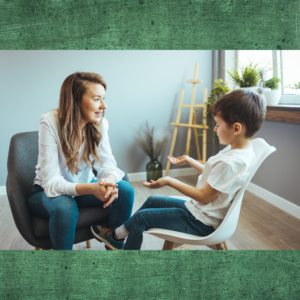 The interviewer’s role is to gather information in a way that is non-leading, neutral, trauma-informed, and fact-finding (not therapeutic). Therefore, they will greet the family but will mostly only interact with the child.
After some time of greeting, the interviewer will ask the child if they are ready to begin. If so, they will walk together to the interview room (which the child has already seen during the tour). The interviewer follows a structured protocol, using open-ended questions to gather information. They avoid suggestive or repetitive questioning and ensure a child-friendly, safe environment.
The interview is video/audio recorded. We do this for multiple reasons.
- To reduce trauma: The goal is to record the interview so that the child only has to share the experience one time (up until trial if that happens). Investigators can review the recording rather than asking the child to repeat painful details multiple times.
2. To preserve accuracy: A recording captures the exact words, tone, and nonverbal cues. This protects against misinterpretation or reliance on memory-based summaries. It is a clear, objective account of what was said.
3. To protect the process: A recording provides us the ability to demonstrate that the questions asked were developmentally appropriate, the interviewer did not lead or suggest answers, and proper protocols were followed.
4. To support the Multidisciplinary Team (MDT): Our model requires a team approach. Team members can observe live, or later review, the interview, allowing for coordinated decision-making without additional questioning of the child.
What a forensic interview is NOT:
It is NOT an interrogation, and our interviewer is not an investigator.
It is NOT a therapy session (though they are trauma-informed)
Interviewer is NOT an advocate, or one “side”.
Their responsibility is to the facts and to the child’s well-being.
The interview plays a critical role in reducing trauma, strengthening cases when appropriate, and ensuring children are heard in a safe and supportive setting.
Voices of Courage conducted 530 forensic interviews in 2025.
Over the next few newsletters, we are going to post a few common myths about child abuse, then talk about facts. We want to dispel some myths related to child abuse because myths can be harmful. Facts keep children safe.
 MYTH: Child abuse only happens in certain types of families.
FACT: Child abuse crosses every boundary – income level, education, neighborhood, race, faith tradition, and family structure. There is no single “profile” of a family where abuse occurs. It can happen anywhere.
One of the most harmful misconceptions about child abuse is that it only affects “other people”. When we believe that abuse is limited to certain communities, we lower our guard in our own. We may overlook warning signs. We may hesitate to ask questions. We may assume, “That doesn’t happen here.” That’s dangerous because it leaves children vulnerable.
The reality is that stress, untreated trauma, substance misuse, isolation, and lack of support can impact families in every zip code. Abuse is not a reflection of a neighborhood’s appearance or a family’s public image.
WHY IT MATTERS: When we understand that child abuse is not confined to one type of family, we become more attentive, more compassionate, and more willing to act. Prevention begins with awareness – and awareness begins by challenging assumptions.
Protecting children is not about pointing fingers. It’s about strengthening families, increasing access to support, and ensuring that when a child speaks up, they are heard and believed.